Introduction
The Mobilization Tax
It appears on no invoice. It is accepted as the unavoidable cost of complexity. It is not unavoidable.
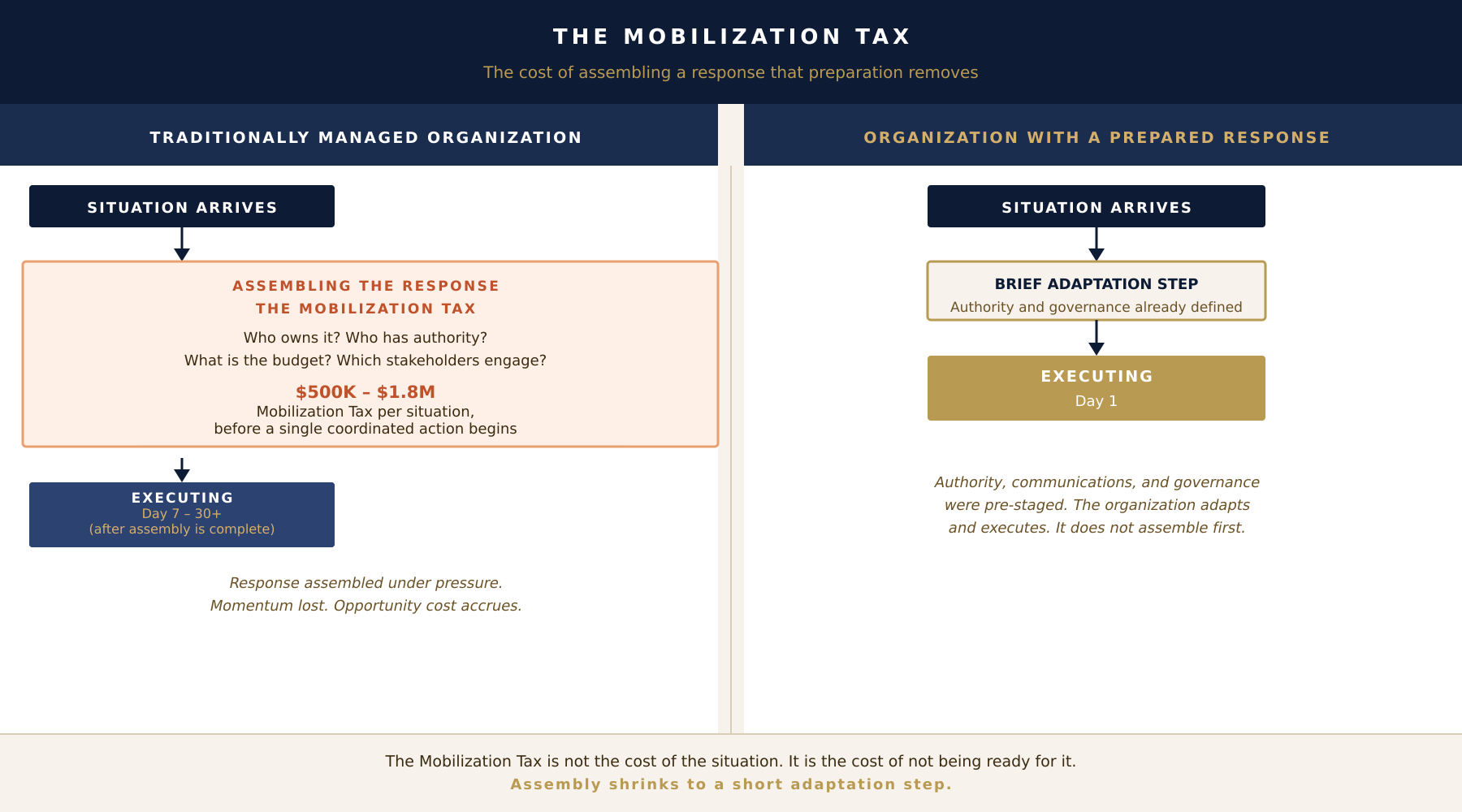
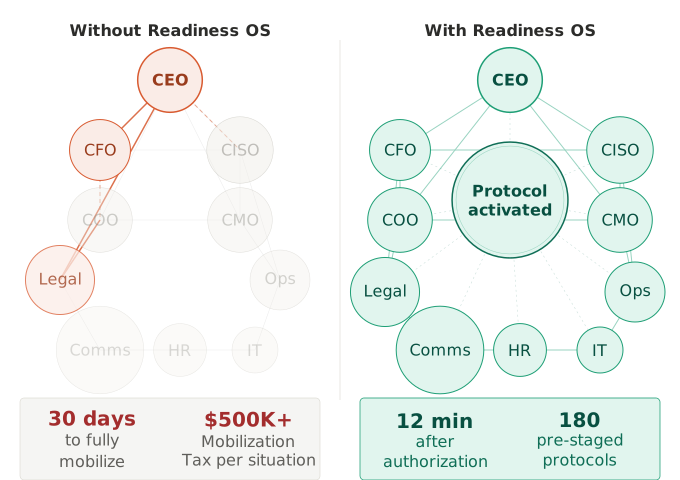
When a significant Strategic Situation arrives in a traditionally managed organization, the first weeks do not go to executing a response. They go to assembling one: who owns it, who has authority, what the budget is, and in what order stakeholders must be engaged. In a prepared organization, authority, communications, and governance are staged in advance, and each response sharpens them for the next one. Assembly shrinks to a short adaptation step, and execution begins in hours.
The Agile Practice Guide, Second Edition describes the consequence plainly: “Without preparation, adoption lags and value is delayed” (Project Management Institute and Agile Alliance, 2026, p. 86). That line frames the Mobilization Tax well, though it does not validate the Enterprise Readiness model. The point reaches beyond agile delivery. Preparation can preserve an organization's ability to use a window before it closes.
Why This Book Exists
I watched the same sequence play out more than once across financial services, in brokerage, banking, and wealth management. A competitor would stumble in public through a technology failure, a regulatory action, or a leadership crisis that made the news. The window would open. The opportunity was real. And the organization would often spend much of that window assembling the ability to respond.
The specifics varied, but in the cases I saw, the assembly pattern was strikingly consistent.
What follows is a composite drawn from several organizations, not one firm's record. Its days and outcomes illustrate the pattern rather than report a single event.
A competing brokerage announces a major technology failure on a Tuesday morning. Its trading platform is down, and retail clients cannot reach their accounts. The news moves fast, and phones at competing firms start ringing.
The window is open. Clients who trusted that firm with their financial futures are looking for alternatives. The question for every competitor is whether it can reach them before they decide on their own.
The first conversation that morning is not about clients. It is about who owns the response. Sales believes it does. Marketing believes the message must be approved before outreach begins. Legal wants to review what can be said about a competitor's trouble. The executive who can authorize the account acquisition campaign is not immediately reachable. Settling those questions takes three days.
Then comes the account list. Which of the competitor's clients fit the right profile? The data exists somewhere in the organization. Finding it, cleaning it, prioritizing it, and getting it to the people who can act on it takes another four days. Nobody built the list in advance, because nobody had prepared a response to this kind of situation.
Then the message. What can the firm say to a prospective client who is frustrated with a competitor? What language will be approved, and who signs off? The drafts go through revision and approval before anything goes out.
By Day 14 the campaign is ready. The list is built, the message approved, the authority settled, and the outreach coordinated.
But the competitor restored service on Day 4. By Day 7 it had issued a public statement, offered account credits, and launched its own retention campaign. By Day 10 the most motivated clients had already decided. When the outreach finally arrives, some have moved to faster competitors and many have chosen to stay. The window was widest in the first three days, and the organization spent them assembling the ability to respond.
When the window closes, it does not reopen. The competitor steadies its story and its clients recommit. The organization finishes assembling its response and finds there is nothing left to respond to.
I watched versions of this across financial services, manufacturing, gaming and hospitality, technology, and defense. The situations differed, but the assembly often looked similar, and the response often arrived after the most valuable part of the window had narrowed.
I did not have language for this pattern then. I have spent twenty years building it.
Now it has names: the preparation gap and the Mobilization Tax. This book lays out the discipline built to close that gap.
That assembly costs more than senior leadership time. Governance overhead builds as approvals route through several functions at once, and stakeholders must be sequenced before coordinated action can begin. The communication is built under pressure, the account list is assembled from scratch, and legal review runs alongside everything else. Then there is the opportunity cost of every account that decided before the response was ready.
McKinsey reported in 2025 that 59 percent of change-initiative value is lost between the initial idea and execution. That finding covers change initiatives broadly, not the Mobilization Tax, and it does not validate the estimates below. It does show that substantial value can disappear before execution delivers the intended result.
I watched this pattern repeat over twenty years. In those organizations, the full Mobilization Tax for a significant situation ran from $500,000 to $1.8 million before a single coordinated action began. The low end reflects leaner senior teams and faster existing governance. The high end reflects sustained C-suite involvement across a full two-week assembly. These are modeled estimates drawn from observed patterns, not audited figures. Chapter 9 shows you how to calculate the number for your own organization.
For an illustrative annual calculation, suppose an enterprise faces 15 to 20 more significant situations in a year, each carrying that $500,000 to $1.8 million Mobilization Tax. Multiplying the endpoints gives $7.5 million to $36 million for that subset. The 15-to-20 count is a modeling input, not an observed annual frequency or a benchmark, and it is far from every situation an enterprise faces. Routine, planned, and less visible situations sit outside this calculation.
McKinsey's September 2026 analysis of a disguised manufacturer workflow offers a useful comparison. It made the hidden work visible, including coordination labor, working capital held up by delays, underused capacity, and revenue missed while decisions waited to move between functions. Less than 7 percent of the cost showed up in the workflow's reported activity. The other 93 percent sat in latency and opportunity cost. The method resembles the Mobilization Tax, because both follow the cost of work across interfaces instead of counting only the work performed. McKinsey did not validate this book's model, and its figures are not a benchmark for the estimates above.
A Strategic Situation is a specific kind of organizational demand, and it is not managed like a project. A project organizes approved work with a defined scope, an assigned owner, and a set budget. A Strategic Situation organizes the coordinated cross-functional response needed to pursue the intended outcome of approved work, an emerging threat, or an unanticipated opportunity. Some situations are planned far in advance: an acquisition closes, a transformation launches, or a regulatory deadline arrives. Others are expected, though their timing is uncertain. Some are rare and high-consequence, and some are genuinely unprecedented. In the enterprises where I worked, I saw roughly one or two truly strategic situations in a month, sometimes more. Alongside them ran a much larger flow of routine and less visible ones. That observation is separate from the 15-to-20 input in the calculation above, which does not estimate the full volume. Strategic Situations demand cross-functional responses, though the functions involved and the time available vary. Enterprise Readiness covers the full spectrum: not only crises and surprises, but the routine and expected situations of everyday organizational life.
In my experience, AI and faster information are increasing the number of changes that call for cross-functional judgment while shortening the time leaders have to respond. More signals do not automatically mean more Strategic Situations; leaders still decide what matters. But preparing only for the small subset in the cost estimate would leave much of the enterprise's work uncovered, including situations that call for adapting rather than following a prewritten protocol.
Strategic Situations span four useful preparation postures: Planned, Anticipated, Infrequent/high-consequence, and Unprecedented. Planned means the work and much of its timing are known. Anticipated means a class of situation is expected, but its timing or exact form is uncertain. Infrequent/high-consequence covers events that are uncommon but would seriously affect the enterprise. Unprecedented covers situations that no prepared pattern fully fits. These postures describe how an organization relates to a situation, not four mutually exclusive departments or a forecast of which event will occur. A single situation can move between them as signals develop. The taxonomy helps leaders prepare for what is known, watch what is changing, and keep room to adapt when reality does not match the preparation. The chapters that follow examine what this architecture requires, and what it may cost when assembly begins only after the window opens.
What This Book Is Really About
The clearest example of preparation finished before pressure did not come from a management study. It came from a football field.
In major college football, most plays run inside a 40-second play clock, and some situations allow less. Teams make it work not because the players think faster than the situation demands, but because the team prepared all week for the situations the game was likely to bring. Authority was settled and the sequences were built before anyone took the field. The 40 seconds is not when preparation happens. It is when preparation becomes visible.
I coached at Stanford. A typical game runs sixty to eighty snaps across offense, defense, and special teams, and for each one the team relied on prepared positions and practiced assignments. Every response was activated, not assembled, while the clock ran. When I returned to enterprise leadership, the contrast gave me a question to test. What if organizations prepared their authority, communication, and response structures before their own windows opened?
We still had to read what was happening on the field. We still had to make good decisions under pressure. But we had prepared the ability to act together.
That distinction stayed with me. We did not simply perform well under pressure. The coordination, the authority, and the communication were in place before the pressure arrived. Game day tested that preparation. It did not create it.
Football is not proof that Enterprise Readiness transfers to the enterprise. It shows something narrower: with a defined clock and recurring situations, preparation lets a team act together before execution begins. Enterprise situations differ in their people, goals, authority, and time, so the transfer has to be tested, not assumed. The Preparation Layer is the space between recognizing a Strategic Situation and deploying a coordinated response.
The management tradition has explained execution, quality, strategy, and decision-making in depth. This book asks what must exist before execution begins: the Preparation Layer between strategic intent and coordinated action. The question is not whether capable people can execute. It is whether the organization has prepared the authority, shared understanding, communication, and response architecture that execution requires.
Enterprise Readiness is the discipline this book proposes. Organizations pursue strategy through many kinds of work, including coordinated responses to Strategic Situations. Between approved strategy and execution lies preparation, and leaders can shape it through their choices about governance, communication, and how responses are staged.
Delivery agility and organizational responsiveness are different capabilities. Enterprise Readiness addresses the second without diminishing the first. It complements iterative delivery by preparing the cross-functional authority, understanding, and response structures an organization needs when the work or its context changes.
The question this book asks you to carry forward is not whether you agree with the framework. It is whether your organization is prepared for the Strategic Situations that will define its future, before they arrive to test it. Answered honestly, that question will change how you lead. ---