The Architecture and Operating Model of Enterprise Readiness
I watched a familiar pattern repeat across the organizations I led. A problem surfaced, the organization worked harder on it, and sooner or later the same problem came back. The instinct was to fix what everyone could see. The lasting answer was to redesign the system that kept producing it.
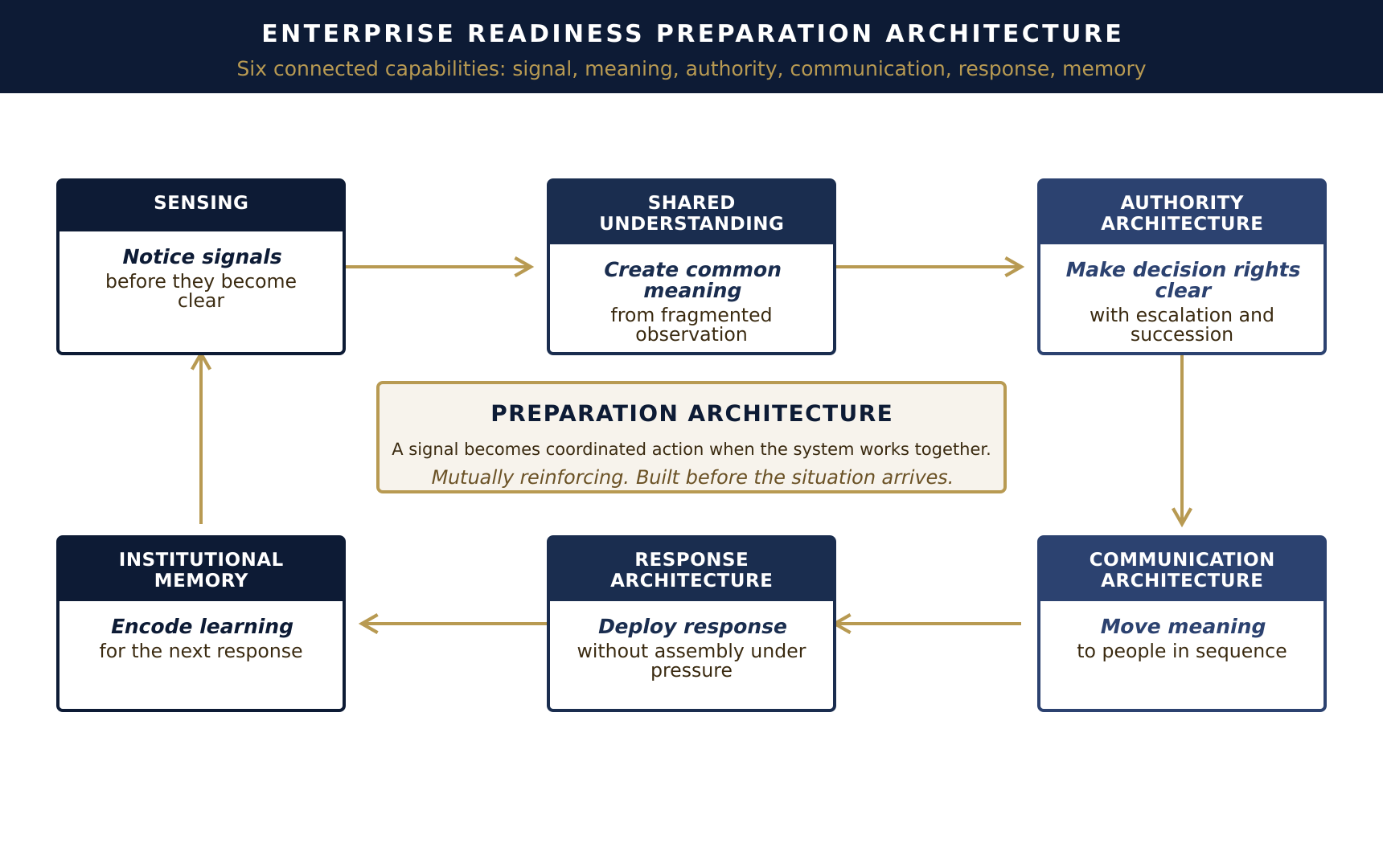
That distinction separates preparation architecture from preparation effort. More effort inside a poorly functioning system can improve the immediate response without touching the conditions behind the problem. A change in architecture can change the patterns themselves. Russell Ackoff's systems thinking makes a related point: persistent organizational problems may not yield to treating each visible symptom as an isolated event.
The six capabilities in this preparation architecture grew out of more than two decades of enterprise leadership. They did not arrive as six separate ideas. I saw that strength in one capability did not always make up for a break in how the system worked together. The value may come from the relationships among them, not from any one capability on its own.
Sensing is the capability to notice meaningful signals before they accumulate into undeniable situations. It is easy to confuse with monitoring, which asks whether predefined metrics remain within acceptable ranges. Sensing asks whether something important is emerging that those metrics were not designed to detect.
A manufacturing organization where I led transformation work had extensive monitoring: real-time dashboards, exception reporting, and operational metrics tracked to the hour. When a supply-chain vulnerability developed, the metrics stayed within tolerance, because the vulnerability was building outside the ranges they tracked. The organization found out when a key supplier announced bankruptcy with thirty days of notice, not thirty days of preparation.
Monitoring did its job: the dashboard answered the questions it was designed to answer. But no one read the signals relevant to the vulnerability together. A sensing review could also ask whether vendor, operational, financial, and external information changes the reading of the supplier's condition. Those are possible review inputs. They are not claims about which signals were present in this case, or proof that an earlier warning would have been reliable.
Shared Understanding is the capability to turn fragmented observation into a common interpretation of what a situation means and what it requires. Different functions can each understand part of a situation while no one brings the pieces together. Shared Understanding can be built through deliberate sensemaking; it cannot be assumed just because everyone received the same information. Without it, the response can be miscalibrated to the situation.
Authority Architecture is the capability to make decision rights, accountability, escalation, and succession explicit before pressure arrives. A succession and delegation map shows who steps in, what responsibility transfers, and how work continues if a decision-maker becomes unavailable. An Authority Map names a primary decision-maker and a delegate. It sets which decisions each level can make and which thresholds trigger escalation. The map also spells out how temporary authority works if a leader cannot be reached. Those arrangements need review against the organization's actual governance and legal requirements. The Authority Map makes these relationships visible before a situation consumes the response window.
Communication Architecture is the capability to move the right meaning to the right people in the sequence a response requires. This is more than distribution. It sets purpose, value, expectations, audience, channel, and timing, so communication creates coordinated action instead of parallel interpretations. The PVE discipline belongs here.
Response Architecture is the capability to turn preparation into a deployable, authorized response. A Prepared Response stages the relevant participants, resources, governance, decisions, and first actions, ready to activate when a situation is recognized. Even so, the organization still has to adapt to what is new. The aim is to shrink the basic coordination that has to be assembled while a window is closing. That may reduce the Mobilization Tax.
Institutional Memory is the capability to encode learning in the system so a future response can begin from an improved baseline. A retrospective alone may not be enough. Learning lasts longer when it reaches Prepared Responses, Authority Maps, communication sequences, sensing systems, or governance.
A useful feedback cycle compares what was expected with what occurred. It identifies decisions or handoffs that did not work as intended and assigns review of proposed changes. Approved changes then carry into the relevant protocol or practice. A later exercise or comparable activation can test whether those changes helped. The aim is to lower the Mobilization Tax on a comparable later situation by improving organizational capability, not only individual memory. Records and reviews do not ensure that result by themselves.
In the cases described, once a response was assembled, teams generally knew how to deliver the work. Many organizations also have established practices for execution. Enterprise Readiness does not improve execution directly. It is meant to improve the conditions execution starts from, so work begins with the relevant authority and shared understanding in place.
The final break appeared when the same organization paid to learn a similar lesson twice. Eric Ries popularized the idea that under uncertainty, validated learning can be more useful than completed plans. Institutional Memory is meant to carry learning into the system rather than leave it only with the people involved. Ackoff warned that data collection can be mistaken for learning. Post-project reviews can record what happened without changing the architecture, Prepared Responses, or governance a later response depends on.
After-action review practice in emergency management and military planning offers a useful comparison. Participants examine what was expected, what happened, and what should change before a later response. That does not establish that every organization improves simply by holding a review. For an enterprise, the test is whether an activation review changes a Prepared Response, an Authority Map, or a communication sequence in a way that improves a comparable later response. A review that records events but leaves the system unchanged risks becoming a completion ritual.
These capabilities form an interacting preparation architecture, not a scorecard or a sequence of departments. A signal without shared interpretation may not become useful knowledge, and authority without communication can fail to become coordinated action. A response without institutional memory risks repeating its assembly cost. The system reinforces itself when it works and erodes when it is neglected, so practices need review as conditions change.
The Readiness Gap may come less from one weak capability than from limited integration among all six. So the real question is whether they connect and reinforce each other, or remain isolated initiatives producing local value.
The Agile Practice Guide, Second Edition offers a related enterprise-level frame, though it does not supply this book’s model. It defines enterprise agility as “the strategic capability to dynamically prioritize, reprioritize, or stop initiatives based on changing business conditions” (Project Management Institute and Agile Alliance, 2026, p. 95). The guide also describes enterprise agility as resting on structural enablers that make rapid, effective adaptation possible across many teams (pp. 103-104).
Those observations sharpen the design question. The six capabilities are the preparation architecture that lets an enterprise sense change, interpret it together, authorize a response, and learn from it. Enterprise Readiness is not an agile extension but this book’s proposed management discipline for preparing a coordinated enterprise response.
The same guide describes an executive-level enablement function, an xMO, as a source of continuous sensing and feedback. It also describes portfolio conditions that can prompt leaders to pause or pivot (Project Management Institute and Agile Alliance, 2026, pp. 100-104). That function is adjacent to the steward described here; I am not claiming the roles are interchangeable. The shared principle is structural: signals must reach the people able to change direction before the cost of waiting compounds.
The Durability Test
A process can be useful without yet being an institutional capability. Good consulting and advisory work can clarify a situation, establish decision rights, align stakeholders, design a response, and help an organization practice it. That work creates value. The durability question is whether the capability stays current and executable after the conditions and builders that supported it change.
The distinction shows up at three levels. A documented process means the organization knows what should happen. An engagement-supported process means it can perform with the people and routines currently assembled. An institutional capability means it can detect, authorize, execute, and improve the response after those people and routines change.
The first level creates a reference and the second a working arrangement; only the third creates enterprise readiness. Movement between them is not automatic. A document does not create shared understanding, and a successful engagement does not by itself create durable authority, communication, or response architecture. The organization has to keep the six capabilities connected, review them as conditions change, and encode what it learns in Institutional Memory.
The decisive test is simple. If the builders left, could the organization still detect the signal, interpret it together, authorize the response, communicate action, deploy what was prepared, and improve afterward? If the answer depends on particular people or expired routines, the preparation is valuable but not durable. Durability is a design requirement, not an automatic outcome of rigor.