Governing Enterprise Readiness
Many organizations govern finance, risk, cybersecurity, and audit. Enterprise Readiness raises a related question: how can the organization oversee preparation for cross-functional situations before a gap becomes costly? This chapter is about what governance should examine, not an argument that existing arrangements are unimportant.
Most executive meetings follow a familiar pattern, starting with financial performance.
Then come operations, project updates, risk reports, human resources, and technology. The meeting ends, and executives may leave believing governance has occurred. Often it has. Yet nobody may have asked whether the enterprise is becoming more prepared. That absence can reflect design rather than a lack of intelligence or commitment. Governance tends to surface what its processes are built to review. If readiness is not in the design, it may not reach the conversation. Amy Edmondson's research on psychological safety adds a second condition. Even a well-designed process can miss uncomfortable signals when people do not feel safe raising them. Governance that punishes the messenger risks learning about important situations late.
At the governance level, Chapter 13's conversational move becomes a matter of design rather than facilitation. The standing questions change. "Are milestones being achieved?" becomes "Is the organization becoming more prepared for the situations most likely to define our future?" The new questions add to operational governance instead of replacing it. Operational questions make sure today's work is done well. Readiness questions ask whether that work is preparing the organization for tomorrow.
From Portfolio Governance to Situation Governance
Portfolio Management has served organizations well, helping leaders prioritize investments, allocate resources, and monitor execution. Enterprise Readiness does not replace portfolio governance. It organizes the portfolio around something more fundamental than project categories. Traditional portfolio governance reviews projects: perhaps fifty active initiatives, sorted by business unit, investment category, risk level, or delivery status. The conversation is about execution: which projects are healthy, which need intervention, and which should be accelerated or stopped.
Enterprise Readiness governance reviews the Strategic Situations those projects exist to address.
Instead of fifty initiatives, imagine starting with six Strategic Situations: Enterprise AI Transformation, Cyber Resilience, Leadership Succession, Customer Experience Evolution, Supply Chain Resilience, and Regulatory Readiness. In this example, relevant initiatives could link to one or more of them, and the conversation might change character. Projects become evidence of the organization's response as well as subjects of oversight. Leadership can ask, "Is this still the right response to the situation it was designed to address, and is the situation still understood correctly?" That question can prompt decisions a routine status review would not.
The Board's Responsibility
Boards of Directors have historically overseen financial performance, executive succession, compliance, strategy, and risk. Those responsibilities stay the same. Enterprise Readiness adds a view of organizational capability. The Board should not manage readiness; that is management's job. It can seek assurance that management is examining whether the enterprise is prepared to execute its strategy in the Strategic Situations that matter. That needs no new committee, only new questions in existing processes. How has the Strategic Situation Portfolio changed since our last meeting? Where does evidence suggest readiness has improved or declined? Which assumptions underpinning our strategy are becoming less certain?
Where are Signal Loss, unclear Decision Rights, Structural Barriers, or weak Psychological Safety most likely to delay the situations that will define the next twelve months? Boards do not need to understand operational mechanics to ask these questions.
They need only exercise their fundamental responsibility: making sure the enterprise is prepared for its future.
The CEO as Chief Readiness Officer
Whether or not the title changes, the CEO keeps executive accountability for the enterprise's readiness. Parts of the work can be delegated, as technology and financial strategy are, while the CEO keeps responsibility for cross-functional integration. The core questions include these. What are we facing? Do we understand it correctly? Are we prepared to respond? Are we learning? None of this makes the CEO a readiness technician. It asks for executive attention to the conditions that make readiness a priority, and accountability for the capability the strategy requires.
Quarterly Readiness Reviews
Executive teams can hold a Readiness Review alongside their operating review while keeping the two conversations distinct. The operating review examines performance and current commitments. A Readiness Review looks at how the Strategic Situation landscape has changed and whether current responses still fit. It also asks where capability may be strengthening or weakening, and what the enterprise may need to do differently. Kaplan and Norton argued for a closed-loop system that connects strategy to operations and feeds learning back into both. Paired reviews are one way to apply that idea, with the Readiness Review adding a forward-looking perspective. The agenda could cover changes to the Situation Portfolio and evidence on the four diagnostics. It could also cover the currency of Prepared Responses, capability investments, and lessons from situations handled during the quarter. Teams may set a time limit, such as 90 minutes, and check whether the meeting stays focused. Duration alone is not a readiness indicator, though repeated trouble agreeing on shared terms is worth examining.
Governing Decision Quality
Organizations often govern outcomes. They tend to pay less attention to decision quality.
Outcomes alone do not reveal decision quality. A sound decision can produce a disappointing outcome when circumstances change, and a poor one can be rescued by luck. Organizations that look only at outcomes risk rewarding luck or punishing circumstances instead of learning how decisions get made. Enterprise Readiness governance proposes reviewing decision quality alongside outcomes. Sidney Dekker's work on complex systems supports examining the conditions people faced, not only the result. Were alternatives considered, and were assumptions explicit? Did relevant expertise take part? Was uncertainty acknowledged? Looking back, leaders can judge both the outcome and the process, especially for decisions made under pressure.
The Stopping Rule for Executive Judgment
Readiness governance should push human judgment upstream only as far as the organization can still examine it. The aim is not to engineer judgment out. Judgment belongs to leadership, especially when a situation crosses domains and needs authority only a senior executive holds. But moving upstream is not neutral. Each step concentrates authority in a smaller group and can hide the evidence for or against the judgment from everyone below.
The stopping rule is clear: stop pushing the dependency upward when the next step would hide the evidence from the governance level below. Dr. Kerry Huang, Forbes contributor and Fortune Global 50 advisor, gave this architecture its most precise formulation in our exchange: governance at the Activation Record level must preserve the right reader at each layer, with final authority held by the final reader rather than compressed into a single point of review. Everything behind the decision must stay available to people positioned to challenge the judgment responsibly. That includes the Activation Record, the protocol, the assumptions, the alternatives considered, the evidence behind the decision, and the outcome. If contradiction requires access only the senior reader has, the architecture has gone one level too far.
Imagine a multi-agency incident response. The incident commander holds final authority, while the operations, communications, and technical leads contribute evidence from their areas.
Before a decision, each lead adds observations to a shared record. Operations describes what is happening in the field. The technical lead explains system conditions, and communications staff report what affected groups are saying.
The commander can choose a different course from a lead's recommendation, but the lead can point to evidence in the shared record. That evidence makes constructive disagreement possible and keeps the basis for the decision visible.
If the evidence is withheld and decisions are made in private, other leaders may have less ability to challenge the judgment or explain its basis. That is a sign authority may have been concentrated too far.
You stop pushing at the point where the people below can still contradict the judgment at the top with the evidence they have. Once they cannot, the architecture has failed before the pressure test arrives.
Governance chains rarely set out to silence contradiction. They can drift past the stopping rule through escalation, exceptions, and private briefings. The risk is that nobody notices when those below can no longer challenge a judgment above.
No system can compel attention. An architecture can make not looking costly by preserving the evidence, the decision trail, and the accountability for ignoring them. It cannot make looking unavoidable; that remains a human obligation. Good governance does not remove that obligation. It makes its exercise visible and its neglect accountable.
The Measure of Good Governance
How should leaders judge whether readiness governance is working? Meeting counts, reports, and dashboards are not enough on their own. The model proposes three outcomes to examine, using evidence suited to each setting.
Are important Strategic Situations recognized earlier? Do executive decisions become more consistent and coherent over time? Does the enterprise mobilize with more confidence and less friction when significant situations arrive? If the evidence shows no improvement, leaders can examine the governance structure and how it was put into practice. Governance should not become an end in itself. Its purpose is to support adaptive capability. If it produces more activity without more capability, its design or application may need revision.
The Enterprise Readiness Diagnostic Record
A governance record does two jobs, depending on which way you read it. Read forward, it shows commitment building: evidence accumulating through use, interventions compounding, and the moat deepening. Reading it backward shows whether that commitment is holding or quietly eroding. Both readings depend on the same visible record. That is why trend direction matters more than a good-looking number at a single point in time.
The Strategic Situation Portfolio as the Starting Point
Every Enterprise Readiness diagnostic record begins with the Strategic Situation Portfolio. Instead of organizing information by department, product line, or function, the record organizes evidence by the situations shaping the organization's future.
The format is simple by design. Each significant Strategic Situation is listed with evidence, trend, and intervention columns for Signal Loss, Decision Rights, Structural Barriers, and Psychological Safety. The record names the executive sponsor responsible for the response and the judgment still to be made. Trend direction shows whether the organization is closing a gap or letting it widen. Executives who watch a score instead of the evidence and its direction misread their readiness position.
Reading the Diagnostic Record
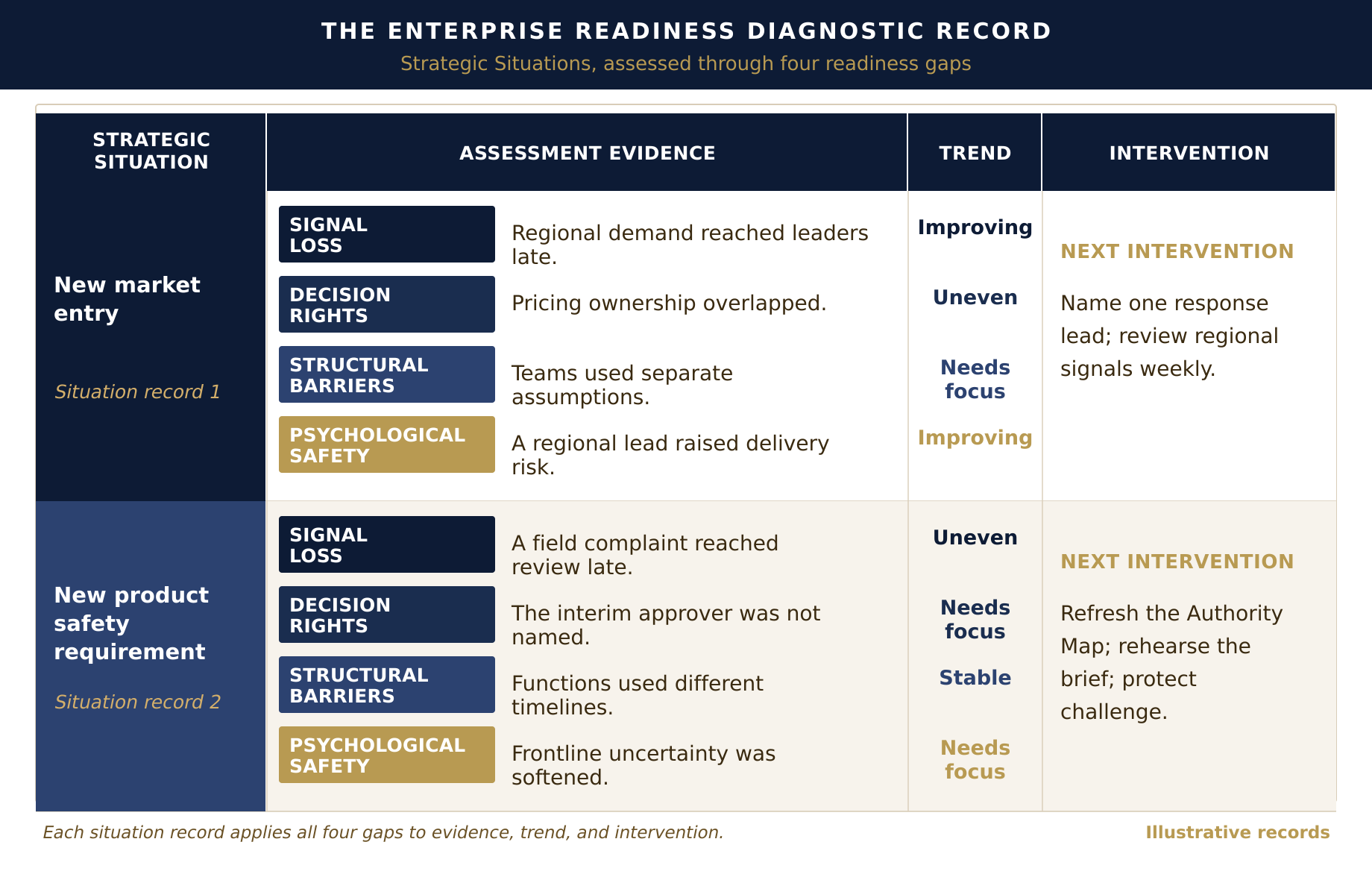
An evidence record organized around Signal Loss, Decision Rights, Structural Barriers, and Psychological Safety replaces the scorecard. For each gap it shows evidence, trend, and intervention, not a composite index or confidence dimension. Philip Tetlock's research on forecasting shows that disciplined judgment about an uncertain future improves when it is tracked over time instead of left to intuition. Reading the record as a trend, not a verdict, makes that tracking possible.
Psychological Safety as Observable Evidence
Psychological Safety is observed through behavior, not treated as a confidence score. Can people surface signals early, name uncertainty, and disagree when the response requires it? The record shows those behaviors alongside the other three gaps and points intervention at the conditions that suppress them.
Governing with the Diagnostic Record
The diagnostic record belongs in the normal rhythm of executive leadership, not in a separate process competing with operational governance for attention. An existing review can make readiness evidence part of decisions leaders already make. A separate meeting may lose that connection. The record is what those standing reviews read from.
The Record Is Not the Discipline
The diagnostic record should not be mistaken for the discipline itself.
Leadership creates readiness; the record only makes it observable. Chapter 18 develops that distinction in full. What matters here is simple. Observation is valuable only if it produces action, and action only if it produces real organizational development.
Executives who use the record well treat it as the start of a conversation, not a conclusion. Evidence of Signal Loss in Leadership Succession is not the answer. It is the prompt: what created the gap, and what will we commit to doing about it before our next Readiness Review? That commitment, made with candor and tracked, builds the adaptive capability the discipline describes. The record makes the gap visible, and leadership closes it.
Perhaps the ultimate measure of executive success should include a question most performance frameworks rarely ask. Is the organization more prepared today than a year ago? If the answer is yes in most quarters, financial performance is more likely to follow. If it is no in most quarters, strong financial results may simply be masking a vulnerability that the rearview mirror will not reveal until it is too late.