A New Discipline of Management
Enterprise Readiness proposes a management discipline for the layer between strategy and execution. That layer is the preparation architecture that may help an organization get ready before a Strategic Situation demands a coordinated response. Its organizing object is the Strategic Situation. The practical work is building shared understanding, pre-staging authority, preparing response structures, and measuring the Mobilization Tax created when that work waits until the window is open. The founding claim is not that management lacks frameworks for strategy or execution. It is that many organizations may lack a shared operating discipline that connects those frameworks to the preparation required before execution is demanded. This book proposes an architecture for that work. It does not claim that no organization or framework already addresses parts of it.
That claim belongs inside the management tradition. Taylor taught organizations to optimize work, and Drucker gave executives a language for objectives and responsibility. Deming made quality a property of the system. Porter made Competitive Strategy a management discipline, while Christensen explained why successful organizations miss disruptive change. Their frames shaped management. On their own, though, they do not provide the organizing object or integrated operating cycle proposed here for preparing across disciplines around a Strategic Situation. Enterprise Readiness seeks to connect that expertise; it does not suggest any of these thinkers overlooked the whole problem.
What Enterprise Readiness Is Not
Enterprise Readiness has an ancestry; it does not replace the disciplines that came before it. It draws on questions that strategy, risk, continuity, crisis response, scenario planning, agile delivery, and portfolio management each developed in their own settings. The table gives one primary question per discipline, for orientation only. It does not cover the full range of any profession's work. These disciplines overlap, evolve, and sometimes approach the same problem from different angles.
| Existing Discipline | Primary Question |
|---|---|
| Strategy | Where will we compete, how will we create value, and what choices will guide us? |
| Risk Management | What uncertainties could affect our objectives, and how should we identify, assess, and treat them? |
| Scenario Planning | What plausible futures should inform our choices, and how might we prepare for them? |
| Business Continuity | How will we maintain or restore priority operations when disruption occurs? |
| Crisis Management | How will leaders coordinate decisions and communications during an acute crisis? |
| Agile | How can teams deliver value iteratively and adapt their work as they learn? |
| Portfolio Management | Which investments and initiatives should we select, balance, govern, or change? |
| Enterprise Readiness | What must already be prepared so the enterprise can mobilize around a Strategic Situation when its window opens? |
Enterprise Readiness leaves strategic choice to strategy. It asks what must be in place to coordinate the organization once leaders choose. Risk identification and scenario planning keep their roles; readiness connects their signals and plausible situations to authority, communication, resources, and prepared responses. Continuity and crisis plans remain too. Readiness covers the broader preparation that can make cross-functional mobilization possible before a disruption. The decision to activate stays with accountable leaders. Delivery teams still plan, test, learn, and adapt within their own area, and portfolio management remains essential for investment and governance. Each brings its own knowledge, controls, and action to the response.
The difference is the organizing object. Most disciplines organize around a question within their own scope. Enterprise Readiness organizes preparation around the Strategic Situation: the named demand that brings those questions together, involves multiple functions, and creates a time-bounded choice. One situation can call on strategy, risk, operations, legal, finance, continuity, communications, and delivery at once. None of them gives up its professional standards or decision rights by joining. The shared object shows how each function's work relates to the situation, so handoffs can be prepared before pressure makes them difficult.
This also keeps the discipline from being mistaken for a crisis program. A scheduled product launch is a Strategic Situation even when no emergency exists. Strategy defines the market choice, portfolio management aligns the investment, risk practitioners test dependencies, and delivery teams iterate. Continuity, communications, and legal practitioners prepare for whatever could disrupt the launch. Readiness connects that work to the situation, names the authorities and handoffs, and learns from the result. The same architecture can support an anticipated regulatory decision with an uncertain date, or an infrequent but consequential supplier failure. It can also support an unprecedented shift that no existing protocol fully covers. What changes is the preparation posture and the degree of adaptation required, not the legitimacy of preparing.
Nor is Enterprise Readiness a command center that takes authority from the people closest to the work. A shared record makes dependencies and options easier to examine; it does not settle disagreements or make the choice. Executives remain accountable for authorization, and domain leaders for their judgments. Delivery teams remain accountable for execution within the authority granted to them. Preparation supports an informed choice; it cannot guarantee the choice will succeed. Afterward, the organization can record what was proven or disproven and decide whether the response architecture should change. The Strategic Situation then becomes a unit of learning as well as preparation.
The architecture connects those disciplines without absorbing them. Strategy still sets direction, risk practitioners assess exposure, continuity teams protect essential services, and crisis leaders coordinate acute response. Agile teams own iterative delivery, and portfolio leaders manage investments. Enterprise Readiness adds a cross-functional layer for preparation and learning. It asks which situations matter, what can be readied in advance, who holds authority, which signals deserve attention, and what each activation teaches. It is one discipline in a management tradition, built to help the others contribute coherently when a Strategic Situation crosses their boundaries. The right design respects existing disciplines and practitioners while making their coordination visible enough to prepare, test, and improve.
From Definition to Practice
One bounded operating example comes from elite college football and the NFL. There, teams coordinate again and again under a defined game clock and a known set of rules. Coaching at Stanford, I watched teams prepare for recurring kinds of situations, delegate roles, practice communication, and activate responses between plays. A game can hold dozens of those cycles in a few hours. That is real operating evidence of how preparation supports coordinated action in a stable, rule-bound system. It is not a direct model of an enterprise, where people, objectives, authorities, and the situation itself can change. Football shows the value of preparing before a defined clock; whether that transfers is a hypothesis to test.
Adjacent disciplines contribute relevant concepts and practices. High-reliability organizing studies how teams manage risk and notice failure signals in hazardous systems. Organizational resilience examines how systems absorb disruption and recover. Adaptive leadership addresses challenges without ready-made answers, and incident command sets roles in emergency response. Mission command enables decentralized action within intent. Organizational ambidexterity explores how organizations balance current operations with adaptation. This book does not claim these fields are incomplete on their own terms. It asks whether their contributions can be connected around the Strategic Situation as a shared object of preparation.
Enterprise Readiness complements them but owns a different problem: preparing a portfolio of Strategic Situations before coordinated action is demanded. Its domain is the Preparation Layer, its economic measure the Mobilization Tax, and its operating mechanism the Prepared Response, improved through the Activation Record. It prepares the enterprise for threats, opportunities, transformations, and known commitments, not only crises.
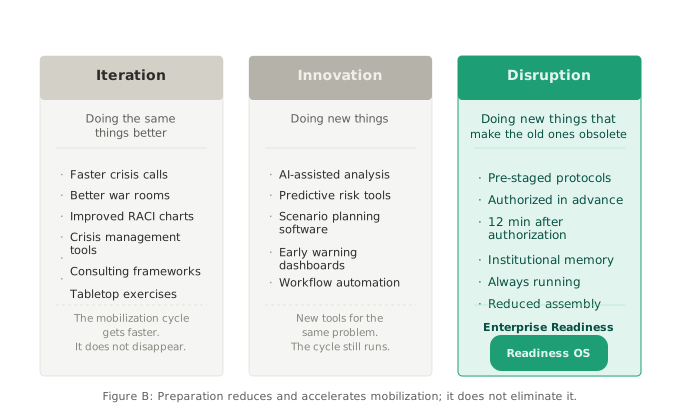
That is why the discipline is structural and not only behavioral. Leaders may know they should communicate better, collaborate, decide faster, and learn from experience. Yet they may have no shared process for preparing those conditions before a situation arrives. In the cases in this book, the open questions were practical. Who convenes, and which functions interpret signals together? What authority can move without another approval cycle? Which legal and financial questions can be answered in advance? How will the Activation Record shape the next response? When those arrangements are missing, leaders often assemble them under pressure while the window narrows. That assembly is part of the Mobilization Tax.
The discipline makes that gap visible and testable. Take the last three significant Strategic Situations your organization faced. Count the days from recognition to a coherent, authorized response, and price the senior leadership time consumed. Then ask which decisions, relationships, authorities, and communication sequences could have been prepared in advance.
Suppose the next comparable situation mobilizes faster and at lower cost because those elements were built into the system and learned. Then the discipline is doing what it promises. If not, the framework or its implementation needs correcting. Like any discipline, it has to earn its place through outcomes rather than advocacy.
The contribution may be larger than cost reduction. If preparation shortens assembly, some leadership capacity comes back. Depending on how much is recovered and what else competes for attention, executives may take on more Strategic Situations with the same leadership pool. Resource allocation can become more deliberate and less like triage. Senior leaders may spend less time rebuilding coordination and more on competitive positioning, acquisition decisions, talent, and growth. The intended benefit is a wider set of viable choices, not speed alone.
Consider one illustrative product-safety Readiness Protocol. Quality staff use its lot-trace map, escalation roles, and decision checklist to investigate routine supplier variances. Most close without a recall, but each use tests whether facts, owners, and authorities are current. If later testing establishes a serious contamination risk, accountable leaders can authorize the same protocol for a high-consequence recall. The prepared lot map supports scope decisions, and the same cross-functional contacts are available. The communication pathway supports notices subject to legal and regulatory review.
This is not a reported customer outcome, and preparation does not guarantee how a recall turns out. The economic case counts both uses. One preparation investment helps coordinate ordinary work and stays available when a consequential window narrows.
That potential capacity matters. A prepared enterprise may be able to stage a market entry, a competitive displacement, or an acquisition move before the window opens. With a fully configured protocol under controlled conditions, mobilization and coordination are in full motion 12 minutes after executive authorization, when protocols are pre-staged. It is a validation target, not a universal customer outcome. The architecture may also help leaders pursue Strategic Situations that competitors have not prepared to answer. Enterprise Readiness is not only defensive; it is intended to expand the options an organization can consider.
The Evolutionary Argument. In some industries, slower competitive timelines once left room to assemble a response after an opportunity or threat appeared. Other settings have always had short windows. AI can compress parts of analysis and execution, and regulatory changes and market opportunities arrive on different timelines by sector. Where a window is short, organizations that cannot mobilize inside it may lose options before they act. The management tradition built disciplines for the conditions of its time. Enterprise Readiness proposes another architecture for recognizing, authorizing, and acting in time, to be tested where timing matters.