Readiness OS
A discipline can become easier to practice consistently at scale once it has shared standards and supporting infrastructure. That infrastructure need not be software. Accounting, for example, developed Generally Accepted Accounting Principles.
Deming set out his System of Profound Knowledge for quality, and PMI published the Guide to the Project Management Body of Knowledge. Each gave practitioners a framework for applying ideas consistently. Enterprise Readiness follows a similar path, except that its discipline and platform were codified in parallel. The Execute phase shows how the two relate: its common language, reporting cadence, and gap diagnostic came from organizational practice before they were built into software. This book describes the discipline, and Readiness OS is designed to put it into practice. Together they may make preparation work more persistent and executable at scale.
Until now I have avoided discussing technology. The discipline should guide the choice of technology, not the other way around. A tool built before the problem is understood tends to automate existing processes rather than enable better ones. The principles, language, architecture, governance, maturity model, assessment, taxonomy, and operating philosophy are now in place. So the book turns to the platform built to support them.
Enterprise Readiness is the proposed management discipline. Strategic Situations are what an organization prepares to recognize and address. Readiness OS is a platform built to support that preparation. It does not replace existing enterprise systems, and the work can begin with the tools, governance, and leadership practices already in place. Whether the platform makes preparation easier to sustain is a separate question from whether the discipline matters. Software that behaves as designed does not, by itself, prove an organizational outcome.
The System of Record That Was Missing
Modern organizations have extraordinary technology infrastructure, and each system is the system of record for something. ERP holds financial transactions.
CRM holds customer relationships, HRIS holds employees, IT Service Management holds technology operations, SIEM holds security, and PPM holds projects. Knowledge also lives in collaboration and document systems. In the organizations I observed, none of them gave the enterprise a shared record of its Strategic Situations. They held the parts, such as budgets, talent, initiatives, customers, or security exposure. The situation connecting those parts was often scattered across presentations, email, and individual memory. Readiness OS is designed to make the Strategic Situation a first-class enterprise object. That object has its own identity, history, attributes, links to relevant organizational information, and record of what was learned.
What the Platform Enables
One distinction defines how the technology relates to the discipline. Readiness OS does not make decisions, replace judgment, or create readiness. Readiness depends on leadership behavior, culture, governance architecture, and learning from Strategic Situations. The platform is designed to make parts of readiness observable and to give executive judgment information, history, and a view of the organization's preparation. It can support three capabilities that may be hard to sustain by hand at scale.
The first is organizational memory. When a Strategic Situation is recorded, the platform can keep its signals, recognition time, shared understanding, Prepared Responses, decisions, and consequences. The record helps only if leaders study what happened and carry the learning forward.
The second is Prepared Response management. A Prepared Response should be a capability, not a static document. Readiness OS supports developing responses, proposing refinements after activations, surfacing them when a new Strategic Situation matches a pattern, and reviewing them. Take the illustrative competitive-displacement case. A leader could see the convening sequence, delegated budget authority, and the prior legal review with its refresh date. Communications owners and resources staged for release on authorization would be visible too. All of it can be prepared before the situation arrives.
The third is situational awareness at scale. An executive team usually cannot watch every relevant signal directly. Working with artificial intelligence, Readiness OS is designed to monitor authorized sources, connect signals across functions, and point leadership toward patterns worth reviewing. Examples include regulatory commentary, competitor hiring patterns, shifts in customer sentiment, and vendor or supply-chain health indicators. The division of labor is deliberate: AI monitors and executives authorize. The platform surfaces information for consideration but does not make or authorize the decision. As built today, Readiness OS organizes this capability as a library of Prepared Response protocols, called Readiness Protocols. They span the operational domains in which the enterprise prepares to act.
The Accountability Firewall
Readiness architecture enables coordination; it does not take decision authority from accountable leaders. The boundary is explicit:
| Readiness Architecture Owns (Enablement) | Line Leadership Retains |
|---|---|
| Detection: organize relevant signals and surface patterns for review | Situation judgment: determine what signals mean in context |
| Signal aggregation: connect information across authorized sources and functions | Decisions: choose whether to act, adjust, select another response, or stand down |
| Protocol activation support: surface a relevant Prepared Response and coordinate an authorized activation workflow | Authorization and accountability: approve activation, set direction, and remain answerable for the decision |
| Prepared roles, dependencies, communications, and a governance record | Execution outcomes: direct work within granted authority and own its consequences |
“Activation” describes the protocol workflow after an authorized leader decides. It does not mean the software, on its own, declares a Strategic Situation or starts consequential action. Detection and preparation belong to the architecture. Decisions, accountability, and execution outcomes remain with human leadership and the accountable line functions.
When a situation arrives, some mobilization work may already be staged. How much remains depends on how well the Prepared Response fits. The platform also offers a short Readiness Benchmark as a simple onramp to the assessment framework in Chapter 15. Onboarding follows the sequence proposed in Chapter 13: vocabulary first, diagnosis second, and initial Prepared Responses third. The platform is designed to put that sequence into practice, so an organization beginning the discipline and one opening the platform for the first time can follow the same general order of work.
The same architecture has to serve different people and kinds of value. Take a planned market entry. The chief executive weighs the choice, and finance sets spending authority. Marketing and revenue leaders prepare the outreach while legal reviews what may be said. Operations maps dependencies. The PMO or Chief of Staff can make cross-functional handoffs visible. A regulatory change may call on the same roles in a different order, with legal and risk judgment nearer the front. In either case, technology leaders must make sure the information and integrations in use are authorized and reliable. These examples show how role-specific preparation could be organized; they are not accounts of completed customer activations. The platform can stage the relevant roles and record an authorized decision, but it cannot decide for those leaders or guarantee the result.
The Architecture of the Platform
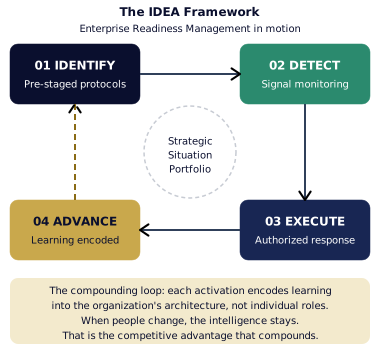
The architecture of Readiness OS reflects the architecture of Enterprise Readiness itself through the IDEA Framework. IDENTIFY establishes the organization's Readiness Protocol library, trigger definitions, ownership, authority, and preparation before a situation arrives. DETECT monitors relevant signals and recognizes an emerging situation while a response window remains open. EXECUTE turns executive authorization into coordinated action across stakeholders, resources, communications, dependencies, and Readiness Protocols. ADVANCE captures what was learned from the activation so the organization is more ready for the next situation.
Preparation gets the organization ready, and detection tells it when to move. Execution is where the response either holds together or falls apart.
In the dozen major transformations I observed, execution was often where the gains from preparation were hardest to keep. The trouble came not only in planning or activation but also in the execution window. That is when the situation was live and the organization could slide back into old habits. Email chains sometimes replaced structured communication. Status meetings could stand in for accountability, and information could lose fidelity as it moved through the layers of the organization.
Preparation is meant to reduce the assembly cost behind the Mobilization Tax, though it cannot remove every delay. A second cost can arise inside execution: misaligned work, ownership that dissolves at a handoff, or decisions that never reach the person who needs to make them. In the organizations I observed, those problems could last through a long activation. I did not measure their cost separately from the Mobilization Tax. The Execute phase is designed to help address them.
EXECUTE is the operating phase inside an authorized protocol activation. It is not a separate module, a replacement for project management, or a parallel system of record. One authorized activation record is the source of truth from authorization through outcome and learning.
Execution runs on a common language that every layer of the organization can read. The delivery team, the program layer, and the executive see the same work. Each sees it at the depth it needs, on a cadence matched to the decisions it must make. When something breaks, the structure names which part failed. The executive then knows what kind of decision will close the gap, instead of asking for more information.
In the organizations I worked in, many execution failures came down to an ownership gap at a shared handoff. The work had an owner on one side and no clear owner on the other. Teams did not always call it that. They called it a communication problem, a coordination issue, or a process breakdown. Naming the gap precisely can help leaders choose a more relevant intervention, though it may not close the gap right away.
This framework did not come from theory. I built it in organizations from startups to Fortune 100 companies, for transformation programs that could not afford to fail. Every PMO I built and every transformation I led ran on some version of this common language and cadence. The diagnostic came from watching the same handoff break in the same place. I saw it in enough organizations to know the problem was structural, not a people problem. These are practitioner claims about work I led, not universal benchmarks.
The recorded execution evidence flows into ADVANCE, which learns from the difference between preparation and reality without rewriting history.
The platform formalizes parts of the method I used to run by hand. At its center, the Strategic Situation Portfolio can hold an inventory of the situations an organization chooses to monitor, understand, or address. When the portfolio is kept current, its records can include diagnostic evidence, trend direction, an executive sponsor, Prepared Responses, and decisions. Governance processes can be linked to the situations they address, which makes Readiness Reviews, Board updates, and decision records easier to find together. The diagnostic record described in Chapter 17 organizes evidence, trend, and possible intervention around Signal Loss, Decision Rights, Structural Barriers, and Psychological Safety.
Together, these elements are intended to support an operating system for readiness.
Illustrative Scenario
The scenario below shows how the Compounding Loop can change an organization's starting position when a similar situation returns. Its details and figures are hypothetical. They are not drawn from a specific event or offered as measured results.
An organization activates a competitive displacement response for the first time and pays the full Mobilization Tax. Assembly takes eleven days. The team needs eight cross-functional alignment meetings before coordinated action begins. Authority is settled under pressure, and the account list is built from scratch.
Afterward, the team logs the activation and refines the recognition criteria. Leaders document and pre-delegate the authority structure, and the account list is updated every quarter.
Eighteen months later, imagine the same type of situation arrives. This time the response mobilizes in four hours. Authority is already in place, and the communication sequence needs adapting rather than inventing. In the scenario, the organization captures thirty-one accounts, compared with eleven during the first activation.
The Compounding Loop did not make the team smarter. It made the second activation start where the first one ended.
The Relationship Between Discipline and Platform
Practice helped make the proposed discipline explicit. The Seven Laws, the Architecture, the Operating Model, the Maturity Model, the Assessment Framework, and the governance approach can all be practiced without Readiness OS. Organizations managed Strategic Situations long before software existed to support them. A platform may help sustain the work across many leaders, situations, and years, where manual processes and individual memory become harder to maintain.
The platform is not useful unless the discipline is understood. Without the platform, the discipline may run into administrative limits. Together they may provide what neither supplies alone. That is why the first seventeen chapters cover the discipline before this one turns to the platform. Readiness OS is one possible infrastructure for the discipline, not a prerequisite. Inside large organizations, I watched initiatives end and institutional knowledge disappear when teams moved on or organizations reorganized. That experience helped motivate the platform.
Once the diagnosis is clear, the hesitation is usually not disagreement. It is uncertainty about where to begin without creating another initiative that competes for the same attention and resources. Chapter 13 answers with a First 100 Days sequence: establish the vocabulary, make the diagnosis honest, and build the first Prepared Responses around situations already demanding attention. The organization does not need to wait for a perfect system. It needs to begin making the Preparation Layer visible.
The discipline needed infrastructure to make its value last. Readiness OS does not guarantee permanence. It does support scale, persistence, connection, and sustainability beyond what manual administration can reliably provide.
Persistence is not automatic learning. After an activation, a specific finding can inform a proposed revision to the prepared response. That revision is reviewed and approved before the updated protocol carries forward. This traceable chain makes learning possible and visible. It does not promise that every revision will make the response more accurate. The architecture supports improvement while preserving the evidence and decision that produced the change.
That infrastructure carries obligations equal to the sensitivity of the work. People must authorize every activation. Records must stay with the organization that owns them, and every integration must be approved and auditable. Public demonstrations are modeled, not customer operating records. Under controlled conditions and with protocols pre-staged, the 12-minute target begins at human authorization and ends when mobilization and coordination are in full motion. Like the Mobilization Tax, it remains a validation method until customer baselines and post-activation evidence establish an outcome.