Communication Creates Alignment
A 30-minute check for shared meaning can surface different interpretations before they turn into weeks of corrective execution.
Communication creates alignment when the people who must act test what they heard against what was meant. Information alone does not become coordinated action. The progression runs from Information to Shared Meaning to Alignment to Coordinated Action.
Two people can sit in the same meeting, hear the same words, and leave with different understandings of what was decided, without either being careless. Each processes the discussion through a different framework and a different sense of what matters.
Herbert Simon's work on bounded rationality helps explain why people often decide without weighing all the information available. They settle on what seems sufficient from where they stand and within what they can process. People receiving the same information can build different meanings from their experience and responsibilities. In the organizations I worked in, dashboards, reporting, and town halls sometimes added information without testing interpretation.
A transformation failure I diagnosed inside one large organization shows the difference. The executive team clearly presented a decision to restructure its program management function. Ninety days later, implementation had drifted far from what leaders intended. Four divisions had interpreted the decision as methodology standardization, governance consolidation, talent development, or cost reduction. Each reading had a basis in the original communication. Together they produced four initiatives where leaders expected one. The decision had been communicated; its meaning had never been tested with the people who had to act on it.
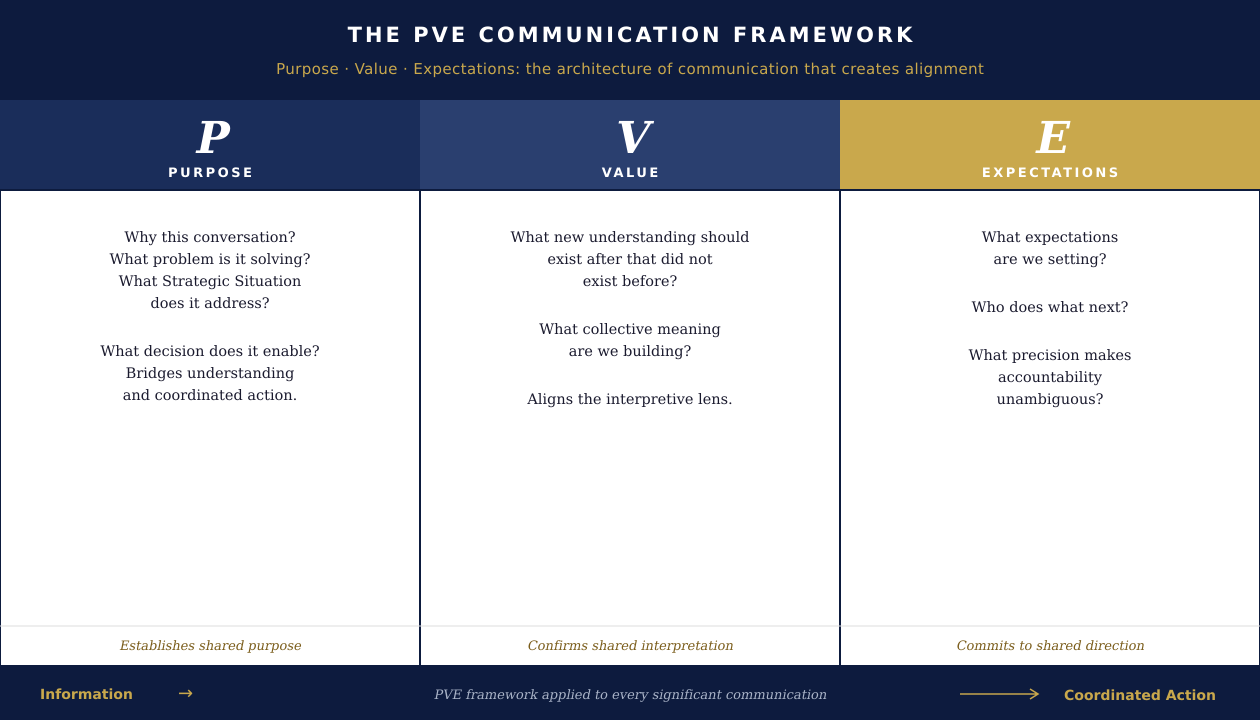
Chip and Dan Heath documented why the same message can land differently in different minds. I developed PVE (Purpose, Value, Expectations) so leaders could test shared meaning in a significant conversation, not just transmit more information.
Purpose: Why are we having this conversation? What problem or Strategic Situation does it address, and what decision does it enable? Without a shared purpose, one person can hear cost reduction while another hears capability development.
Value: What new understanding should exist when the conversation ends? If everyone leaves with the same information but different meanings, there is no alignment yet.
Expectations: Who will do what next, and whose interpretation of the decision governs the work? I have watched leadership teams reach shared understanding in a meeting and still take different actions because no one settled that last question.
Before that restructuring meeting adjourned, someone could have asked: "Tell me what you heard, rather than what was presented. What do you understand we decided, and what will you do because of it?" That is the meaning check, one of the most useful habits I developed in more than two decades. "Are there any questions?" tests whether people need more information. Asking what they heard tests whether they are working from the same meaning.
In that case, a 30-minute meaning check might have exposed the four interpretations while everyone was still in the room. The possible eight-week saving in corrective execution is an illustrative estimate, not a measured result. This case cannot show that a check would have prevented the divergence or shortened the rework. It does show one communicated decision becoming four courses of action. Finding that earlier would have given leaders a chance to address it.
The cost of untested meaning was even clearer when one group sat outside the organization. A financial services organization I worked with began a complex, 18-month technology transformation with an external development partner, backed by a substantial business case. After a strong two-day alignment session, both teams left confident they understood what was being built and why.
Fourteen months later the partner delivered a technically strong product that worked as specified, but it was not what the organization needed. The internal team had understood it as a customer relationship tool, designed to recognize and respond to individual needs across a complex portfolio. To the partner, it was a transaction-processing tool designed to reduce friction. Both readings fit the same features, and nobody had lied or ignored the specifications. Two capable teams had agreed on every word and built different meanings from it.
The delivered product created measurable value and was counted as a partial success. But another team and partner rebuilt the intended capability over the following two years at significant additional cost. The original sponsor had left the role by the time the second effort finished. A longer specification would have described the features more precisely without settling what the product was for.
A meaning check at the partner kickoff could have asked each team the same thing. "Tell me what you heard, what you understand we agreed to build, and what problem you believe it is designed to solve." It might have exposed the different interpretations before work began. There is no basis to claim it would have prevented the mismatch. The observed cost of the unresolved ambiguity was a second project and two years of work. That is not a measured saving attributable to PVE, but it is a reason to test what an important decision means while people can still act on what they learn.
Bounded rationality is a feature of human cognition, not a defect to be eliminated. Organizations can work with it by checking interpretations at kickoff, across functions during delivery, and after consequential decisions. The Mobilization Tax is the cost of assembling a response after the window opens. Meaning drift can add a different cost as execution continues. A meeting is finished not when its message is sent but when the people responsible can explain the purpose, the decision, and what they will do next.