The Lifecycle of a Strategic Situation
The window for recognizing an emerging situation is often widest before its consequences are certain. As evidence accumulates, the organization gains confidence while some of its options narrow. Early signals can preserve options; late certainty can remove them.
One useful way to examine a Strategic Situation is to trace its lifecycle. Signals become patterns, and patterns shape recognition. Recognition informs executive judgment, judgment authorizes a response, and outcomes generate learning that can be encoded for next time. Real sequences may overlap or diverge.
Two points in this lifecycle are worth examining. At the signal stage, there may still be time to act. By the judgment stage, once a situation is undeniable, the response may have to be assembled under pressure. The gap between them can decide whether an organization captures a window or watches it close. In the cases described here, the obstacle was not an absence of all relevant capability but entering the response process after options had narrowed.
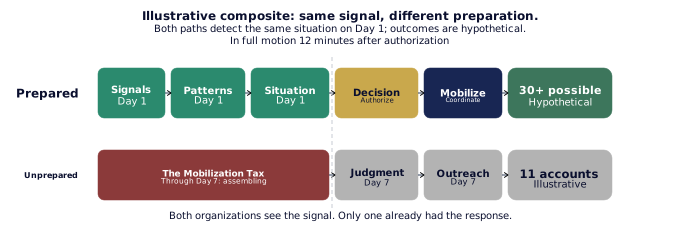
The Introduction's competitive opening took two weeks in its illustrative reconstruction. To examine the lifecycle, use a shorter, hypothetical variant of that cross-organization pattern, not a second account of the same firm or an observed client event. Suppose roughly forty accounts are potential prospects when a competitor's technology failure opens a window. Sales capability exists, but the authority and outreach sequence have not been staged. Watch what happens between the first signal and the first coordinated move.
In the reconstructed sequence, the first forty-eight hours go to settling ownership, budget, and the legal implications of targeting a competitor's accounts. The same hours go to deciding who has authority to redirect sales resources and what governance a reallocation of this size requires. Two days go to assembly instead of outreach.
Account prioritization and approvals run past those first two days, and the first coordinated outreach reaches the market on Day 7. By then the competitor has restored service and steadied its narrative, and the window has contracted. The organization captures eleven of roughly forty potential accounts; outcomes for the others fall outside this illustration. Capturing thirty or more on an earlier-response path is a hypothetical comparison, not an observed counterfactual, benchmark, or forecast. The illustration isolates one possible effect of unprepared mobilization and does not establish that preparation alone would have changed the account outcome.
The illustrative direct cost is roughly $800,000 in assembly and related costs before the sales team was activated. It covers senior leadership time, governance overhead, the account list built under pressure, and legal review. No component breakdown is available for that figure. The organization had the capacity to compete, but its late response illustrates how time spent assembling a response can narrow the options available.
Opportunity loss is modeled separately and is not included in the $800,000. How much of it comes from mobilization delay depends on account accessibility, competition, timing, and the preparation state of a comparable timely response. This reconstruction does not establish a defensible monetary amount.
Enterprise Readiness cannot guarantee that a better-prepared organization will win an account, avoid a loss, or choose the right response. Readiness does not decide which option to take. It aims to keep more viable options open long enough for leadership to decide. The test is not simply whether the organization succeeded or failed. A sharper question is whether it lost options while assembling capabilities that could have existed beforehand: authority, stakeholder sequence, communication, resources, and legal clearance.
I saw versions of this pattern in financial services, gaming and hospitality, manufacturing, and technology. The situation types differed, but the assembly sequence often looked similar, and the response sometimes arrived after the most valuable part of the window had narrowed.
This situation arrived from outside the organization with no clear charter, sponsor, pre-approved budget, or defined scope. Other Strategic Situations may be planned and have owners, budgets, and defined work. Project management remains essential for organizing approved delivery. A Strategic Situation is a demand, planned or emerging, that may require cross-functional coordination to support its intended outcome. This book proposes it as an organizing object that can connect the work of projects and other management disciplines.
Michael Porter's work offers an influential framework for choosing where to compete. That choice still leaves an operating question: how will the organization recognize and respond to the situations that test it?
Across more than two decades of enterprise leadership, I watched portfolio-review agendas give way to situations: a major customer lost, a competitor changing the market, a regulation shifting overnight. The environment changes between strategy cycles, and leadership lives in that space. Strategy tells you where you intend to win. Situations test whether the organization is ready to act on that choice.
A Strategic Situation is worth recognizing because it can have a distinctive pattern, and it can matter at the level of strategy as well as operations. The competitor's crisis put market position in play, not only a quarterly number. Some situations arrive on an uncertain schedule and require coordination across functions. The competitive displacement situation described here involved sales, legal, finance, and governance.
Some Strategic Situations also have a time-bounded lifecycle. In the competitive displacement example, the opportunity opened before it was widely recognized and narrowed as the competitor stabilized. Planned or ongoing situations may follow different timing. Where a response window exists, the organization can lose options before it fully recognizes what is happening.
In this case, the lack of an agreed charter and owner made it hard to route the response through existing processes. Treating the response only as a new project set off a plan, a budget request, and a staffing exercise. That happened during the forty-eight hours when the window was narrowing. Crisis-management procedures may be right for an acute emergency, but they are not the only way to prepare for cross-functional demands. A Strategic Situation may be planned, anticipated, infrequent/high-consequence, or unprecedented, and it can draw on project, risk, continuity, or crisis-management processes as appropriate.
Project management organizes approved work. Portfolio management helps govern investments, and risk management addresses uncertainty and threats. Enterprise Readiness proposes the Strategic Situation as an object around which the relevant parts of those disciplines can coordinate. When management systems focus mainly on projects, an organization can still meet emerging situations with plans that have not kept pace with changing conditions.
Now compare a prepared path within the same hypothetical variant. The situation type, a major competitor facing a public crisis, was in the Strategic Situation Portfolio: anticipated but not scheduled.
When the announcement breaks on this prepared path, outreach authority has been staged for executive authorization and the customer communication sequence is ready to adapt. Legal review was completed for the category ahead of time rather than under pressure, and account prioritization was built from CRM data the previous quarter. The first calls go out on Day 1, with the same situation and the same sales team as the unprepared path. Only the preparation differs.
The gap between eleven accounts and thirty or more, both hypothetical, illustrates how an earlier response might preserve an opportunity window.
Readiness is not built in the window; it is spent in the window.
Donald Sull and Kathleen Eisenhardt's work on simple rules in fast-moving environments offers a useful comparison: some decisions can be clarified in advance without scripting every action. A Prepared Response applies that principle to a class of Strategic Situations. Their work does not establish that this particular model produces a given outcome.
Take your three most significant anticipated situations and ask whether each could be met on Day 1 or would cost you a Day 7. Where the honest answer is Day 7, you have found where your next investment should go.
Some parts of a response can be prepared before a situation arrives; other choices have to be made or revised as leaders learn more.
Seeing Before Acting
Across more than two decades of postmortems, I learned that organizations do not simply observe the world and decide how to respond. They build an interpretation together, often after separate functions have already given the same signals different meanings. Karl Weick gave this process its clearest name: sensemaking. His work shows that organizational understanding is social, retrospective, and ongoing. Organizations do not experience reality directly. They experience the meaning their members collectively make of what they encounter.
That has a costly implication for Strategic Situations. If the collective interpretation is incomplete, distorted, or fragmented across functions, the response deploys against the wrong situation. That happens not because people are incompetent but because the sensemaking process failed.
There is a phrase I heard in almost every postmortem, regardless of industry, size, or whether the situation was a crisis or a missed opportunity.
"We saw the warning signs." Not "we had no information," and not "nobody knew this was coming." The customer complaints were trending up for six months. The turnover data was telling us something.
Competitor moves pointed in a direction we recognized only in retrospect. Some signals were present, but no one connected what they might mean together. That suggests a sensemaking problem as well as an information problem. Weick and Sutcliffe's study of high-reliability organizations describes practices such as attending to small anomalies and integrating what specialists observe. One risk is sensemaking fragmentation: functions interpret signals in their own domains without examining what the interpretations mean together. Technology may assess a system vulnerability while Finance models exposure, Legal identifies regulatory implications, and Operations maps service impact.
When those assessments are not integrated, an organization can miss that several functional issues form one Strategic Situation. I saw a version of this at a financial services organization, where symptoms accumulated across functions while teams addressed them separately. When an earlier strategic bet failed, leaders had to unwind several improvement initiatives, with an estimated $10 million to $15 million in misallocated effort and delayed response. That is a practitioner estimate, not an audited measure. The example shows how information can exist without a process for interpreting it jointly. It does not establish that every organization will face the same pattern.
Gary Klein's field research on how experts recognize familiar situations offers one possible mechanism for faster response. It does not prove that an organizational taxonomy will produce the same effect.
The distinction I eventually drew is between signals and situations. A signal is a piece of information. A Strategic Situation is the pattern that emerges when multiple signals are interpreted together.
In the organizations I observed, earlier recognition was associated with collective interpretation, not only with data. One PMO where I worked had broad visibility across several functions and set up weekly signal reviews instead of relying solely on status updates. Within three months, the team surfaced two developing situations earlier than the existing governance process had. In one case, early recognition gave the organization time to prepare, and the estimated mobilization effort was measured in hours rather than weeks. That was a practitioner observation, not an audited result.
The PMO is not the only suitable steward. Another function may have the access and relationships to connect the relevant observations. Organizations may also enter the lifecycle at different points, anywhere from signals and patterns to recognition, executive judgment, response, and learning. The question that matters is who integrates observations across functions into shared understanding. The answer will depend on the organization's design.